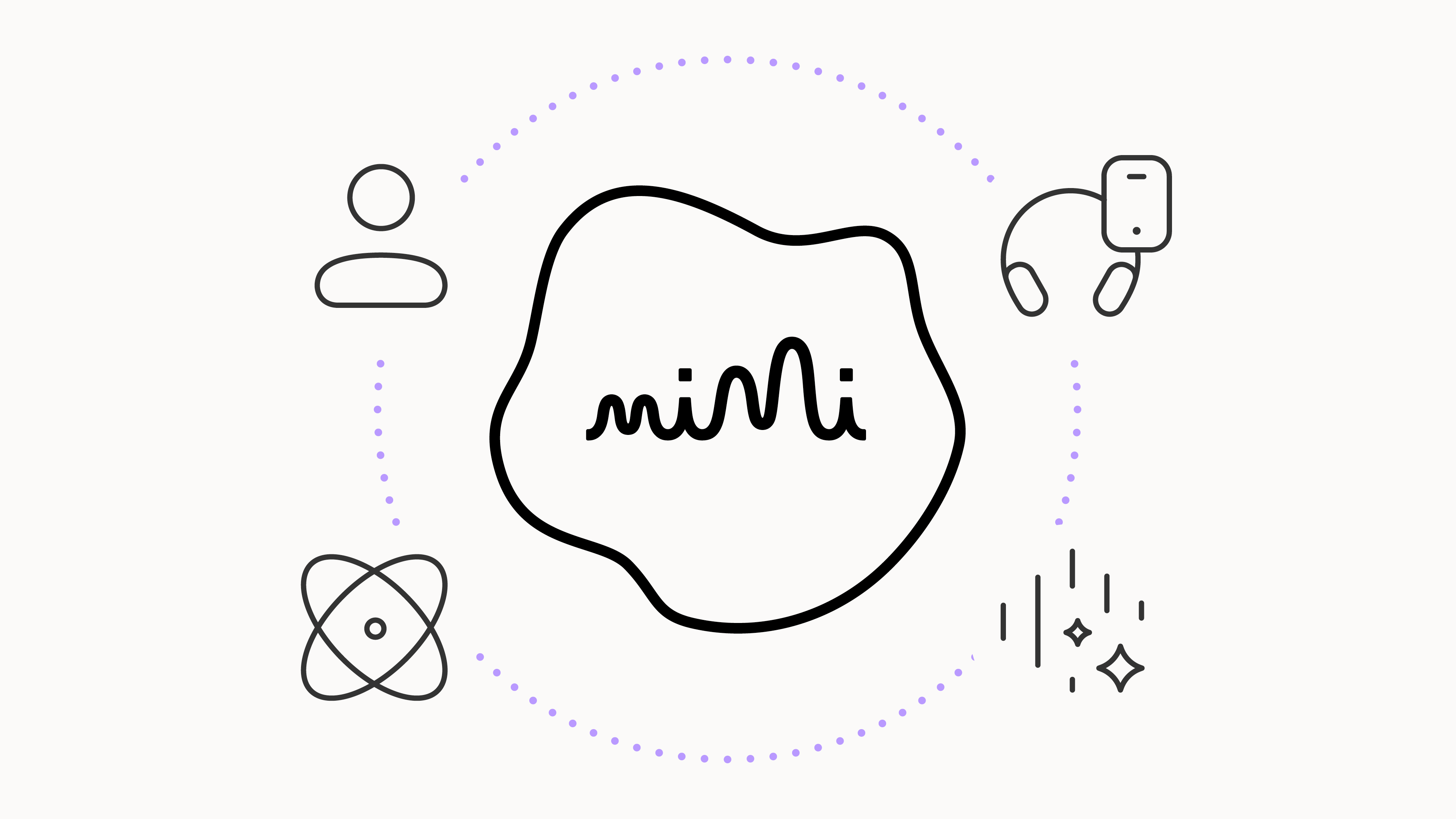
Hearing intelligence helps people hear what matters. It is the ability of a system to adapt in real time to who is listening, what they are listening on, where they are, and what they are actually listening to. Rather than processing sound the same way for everyone, an intelligent system builds a continuous picture of the user and the situation, and adjusts accordingly. The goal isn't just optimizing sound. It's optimizing human communication and cognition, in real time.
Key Takeaways
- Intelligent audio adapts. It responds to the individual listener, the context, and the device.
- Hearing ability and personal preference are both part of the picture. Sound should be shaped around the individual, not just optimized for the average.
- Mimi builds technology that responds to all four dimensions, across a product portfolio spanning personalization, hearing assessment, speech clarity, and scene awareness.
Sound is constant, but the way each of us experiences it never is. The same song might sound different in a quiet room and on a crowded train. The same dialogue can come through clearly on one device and get lost on another. And no two people hear the same sound the same way.
Audio technology has long treated sound as fixed. Processed once, the same way, for everyone. That's beginning to change, as we previously explored in the rise of adaptive audio. But adoption is still uneven, and making all of those adaptive behaviors work together coherently is still the open challenge.
We've written before about how Mimi is shaping the future of sound as intelligent, inclusive, and personal. Since then, our understanding of what that means in practice has only gotten sharper. Thinking less in terms of isolated audio features, and more about how those features work together as one system, responding to the listener and the situation with less friction and more consistency. Think of it as the continuous auditory operating system for AI wearables.
The building blocks
What makes our technology intelligent isn't just the engineering behind it, it's the adaptiveness. Traditional audio processing often relied on a single optimal setting for the average user. Mimi's approach is different: it responds to the individual listener, the device they're using, the environment they're in and what content they're hearing.

User: who is listening
No two people hear the same way. Hearing ability shifts with age, individual physiology, and a lifetime of different listening environments. Mimi understands the listener's unique hearing profile and personalizes the sound experience in real time. Listening preferences matter too. How much someone wants to hear the world around them, how much background noise reduction feels right, how much voice enhancement feels natural, and how they want to fine-tune their personalized sound.

Device: what you listen on
Different types of devices don't just sound different, they're built differently, and come with unique acoustic and engineering challenges. For example, a TV has to project understandable dialogue across a room, a phone works with a few millimeters of speaker, and open-ear devices leave both speaker and microphone exposed to the environment in a way sealed earbuds don’t have to deal with. Mimi adapts to the capabilities and constraints of each device, so audio performance stays consistent.

Environment: where you are
An open-plan office and a city street are both noisy, but in completely different ways, chatter and keyboard clatter versus traffic and wind. The same pair of earbuds has to perform in both. Mimi analyzes surrounding acoustic conditions and optimizes sound for whatever listening context the user is actually in.

Content: what you hear
A live conversation places different demands on the ears than a podcast or a movie does. Mimi interprets what's actually being heard, whether that's speech, music, or mixed media, prioritizing the details that matter most for each.
Hearing intelligence in the real world
Each dimension matters on its own, but together is where the real value shows up.
Take someone sitting at a busy café, catching up with a friend. The place is packed and there is background chatter, music, the hiss of an espresso machine. They have their TWS earbuds in and switch on a live speech focus mode to suit their preference. It zeros in on the voice directly in front of them and filters out the background noise around them. The conversation comes through clearly, without them having to lean in, strain, or ask their friend to repeat themselves.
Or imagine someone listening to a podcast with their smart glasses, and their media is personalized to their own hearing. They step into a busy train station, and the noise around them spikes. The system recognizes the shift and switches modes, restoring the sound details the noise would otherwise mask, so the podcast stays clear without cutting them off from their surroundings. Once they're through the noisiest part and things quiet down, it shifts back to focus on the personalized hearing compensation.
This is hearing intelligence in action, immersion and awareness balanced while reducing the need for the user to be adjusting the audio and settings.
From framework to products
The four dimensions aren't just a framework, they're the logic behind every product we build.
Assessment: A core foundation of understanding who is listening is understanding how someone hears. Mimi's hearing test technology is scientifically validated and built to integrate directly into consumer devices, generating the individual hearing profile that sound personalization builds on.
Personalization: Mimi Sound Personalization puts the individual listener at the center of the audio experience. It tailors streamed media and voice calls to each listener's unique hearing ability, across content types and whatever device they're listening on.
Speech Clarity: Not all speech is the same. A live conversation places completely different demands on the ears than dialogue arriving through a screen or speaker. Mimi Voice Clarity is built for face-to-face conversation and the unscripted speech competing with real environmental noise. Mimi Dialogue Focus is built for dialogue in streamed media, TV, and in-flight entertainment, and works with the content that's already been mixed and is simply hard to follow on playback.
Scene Awareness: This is where environment and content work together most visibly. The system responds to what's actually happening around the listener and adapts the listening experience accordingly. Mimi Noise Adapt restores streamed media audio masked by environmental noise on open-ear devices, automatically shifting into compensation mode as ambient noise increases. Mimi Scene Adapt sits as the system-level awareness layer, understanding the acoustic environment and orchestrating behavior across other Mimi features and device capabilities.
Built on hearing science
Every one of Mimi’s products is grounded in more than a decade of academic research, transforming hearing science into scalable, real-world applications that run on a range of consumer electronics devices.
Our technology uses real-world listening data and scientifically validated hearing tests to adapt audio to each person's unique hearing ability. That hearing testing technology is compliant with the ANSI/CTA-2118 standard, powers the Johns Hopkins Hearing Number app, and has been validated by numerous external studies and research papers.
Mimi's technology is already integrated into consumer devices across the globe, with partners spanning the audio and consumer electronics industry.
What does this mean for your next product?
Hearing intelligence is ready to integrate. Partners can licence individual products to solve a specific problem, or adopt a complete solution tailored to their device category, whether that's Mimi for Headphones or Mimi for Smart Glasses. The result is a device that stands out in a crowded market by being genuinely more personal and situationally aware.
Ready to hear the Mimi difference? Book a demo to talk to our team about how Mimi's technology can work for you.