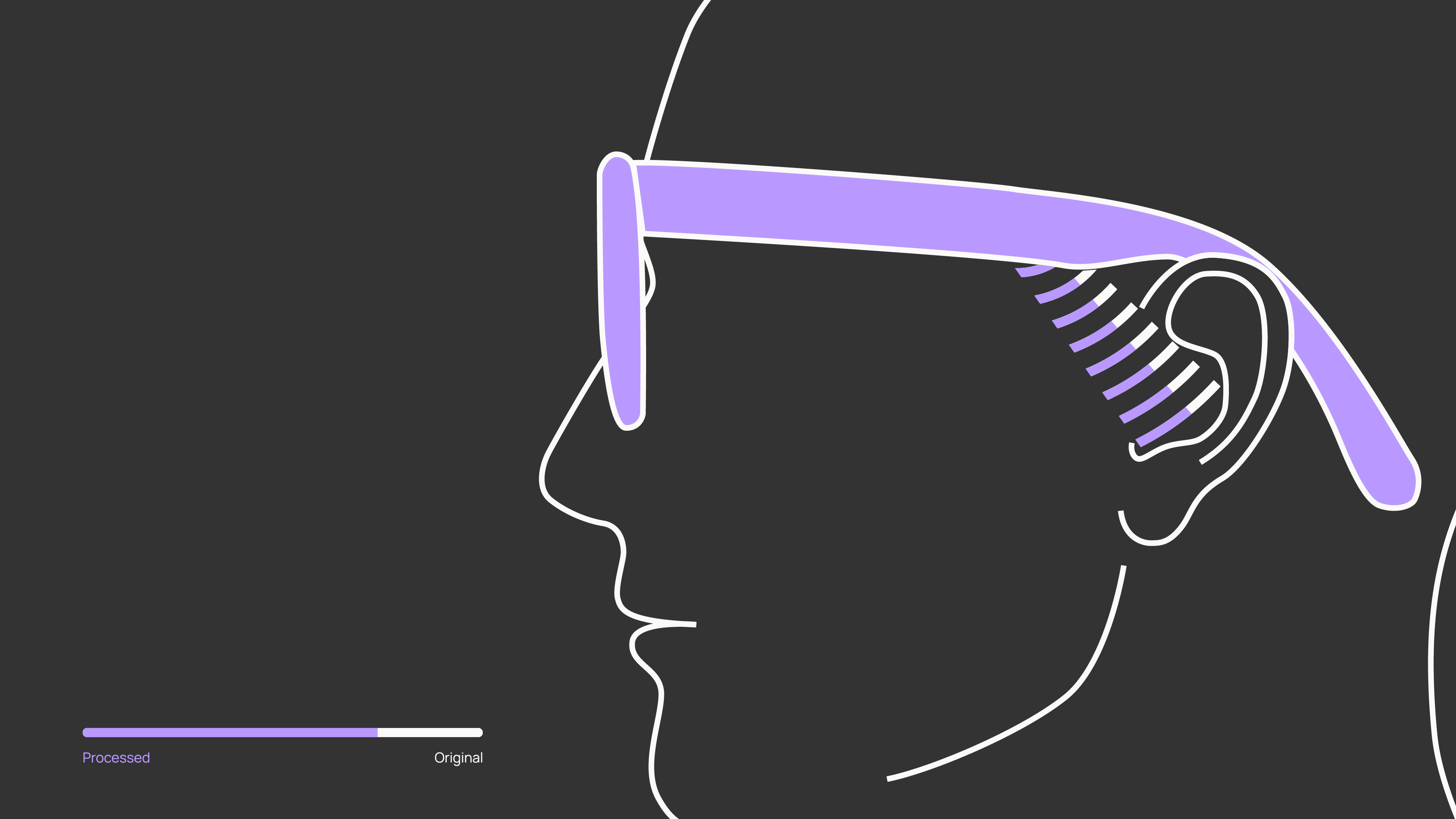
Open-ear devices are changing how we listen to audio in everyday situations.
They offer something traditional audio products can’t: situational awareness, comfort, and seamless integration into everyday life.
But they also introduce a fundamental challenge: in real-world environments, audio clarity breaks down.
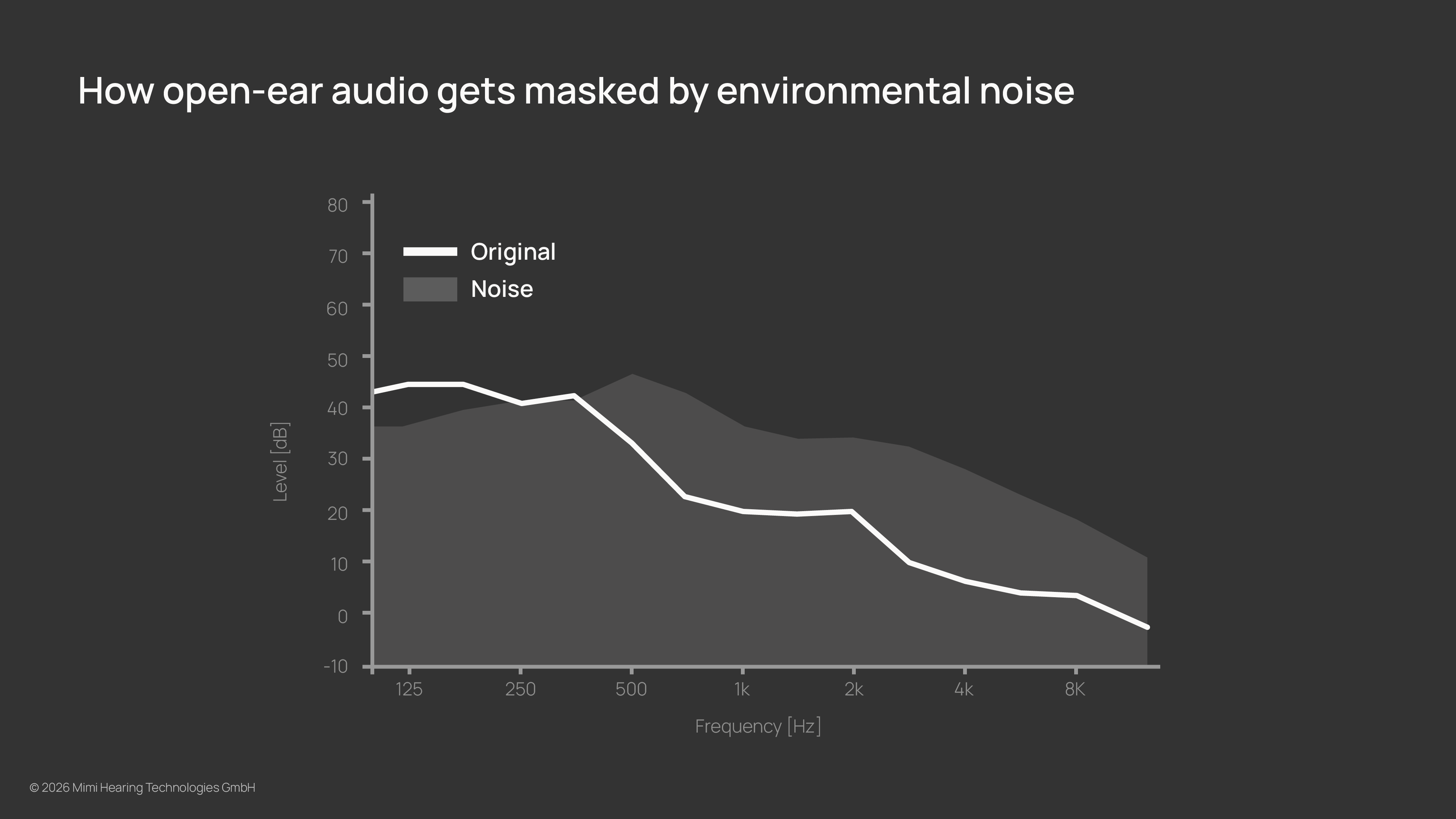
On a busy street, in a café, or during a commute, users don’t just hear more ambient noise, they also lose parts of the streamed audio signal. Speech becomes harder to follow as voices lose definition, and details in music or media start to fade or disappear entirely. This can then degrade the overall listening experience.
Why existing approaches fall short
Most solutions today try to solve this problem by reacting to noise:
- Increasing overall volume
- Applying broad EQ adjustments
- Using Active Noise Cancellation (ANC)
Each has its place but none address the core issue in open-ear devices:
- Volume increases can lead to listening fatigue and distortion
- EQ and adaptive volume apply changes too broadly
- ANC relies on isolation, which contradicts the open-ear design philosophy
These approaches attempt to fight noise but in open-ear scenarios, noise is part of the environment and cannot be removed.
The real problem: audio masking
The challenge isn’t just that environments are loud. It’s that noise masks specific parts of the audio signal, especially low level components at frequencies critical for speech intelligibility and musical detail.
That means some parts of the signal remain audible while others are effectively lost.
Simply turning everything up doesn’t solve this, it often makes the experience less comfortable for the listener.
Introducing Noise Adapt
Mimi Noise Adapt takes a different approach.
Built on Mimi’s expertise in hearing intelligence, it applies insights from human hearing to improve how audio is perceived in real-world conditions. Rather than trying to remove environmental noise, Noise Adapt focuses on the signal itself, restoring the components that are masked in noisy environments.
Noise Adapt doesn’t remove noise, it restores what noise takes away.
By continuously analyzing both the environment and the incoming audio, Noise Adapt dynamically adjusts playback in real time to maintain clarity, without unnecessarily increasing overall volume.

How is Noise Adapt different from traditional audio processing
Noise Adapt moves beyond traditional audio processing approaches:
- Selective restoration instead of overall gain
- Real-time, frequency and level-specific adaptation
- Preserving natural dynamics and listening comfort
Rather than boosting everything, it focuses on what the listener is actually missing, and restores it.
You can see the difference when you compare it to conventional approaches:

What this enables for device manufacturers
For companies building open-ear products, this unlocks a key capability:
- Clearer voice calls in noisy environments
- Improved intelligibility for speech and media
- More consistent audio performance across different situations
- Stronger differentiation in a rapidly growing category
In short, Noise Adapt makes open-ear devices more comfortable, reliable, and usable across a range of everyday conditions.
Designed for open-ear listening
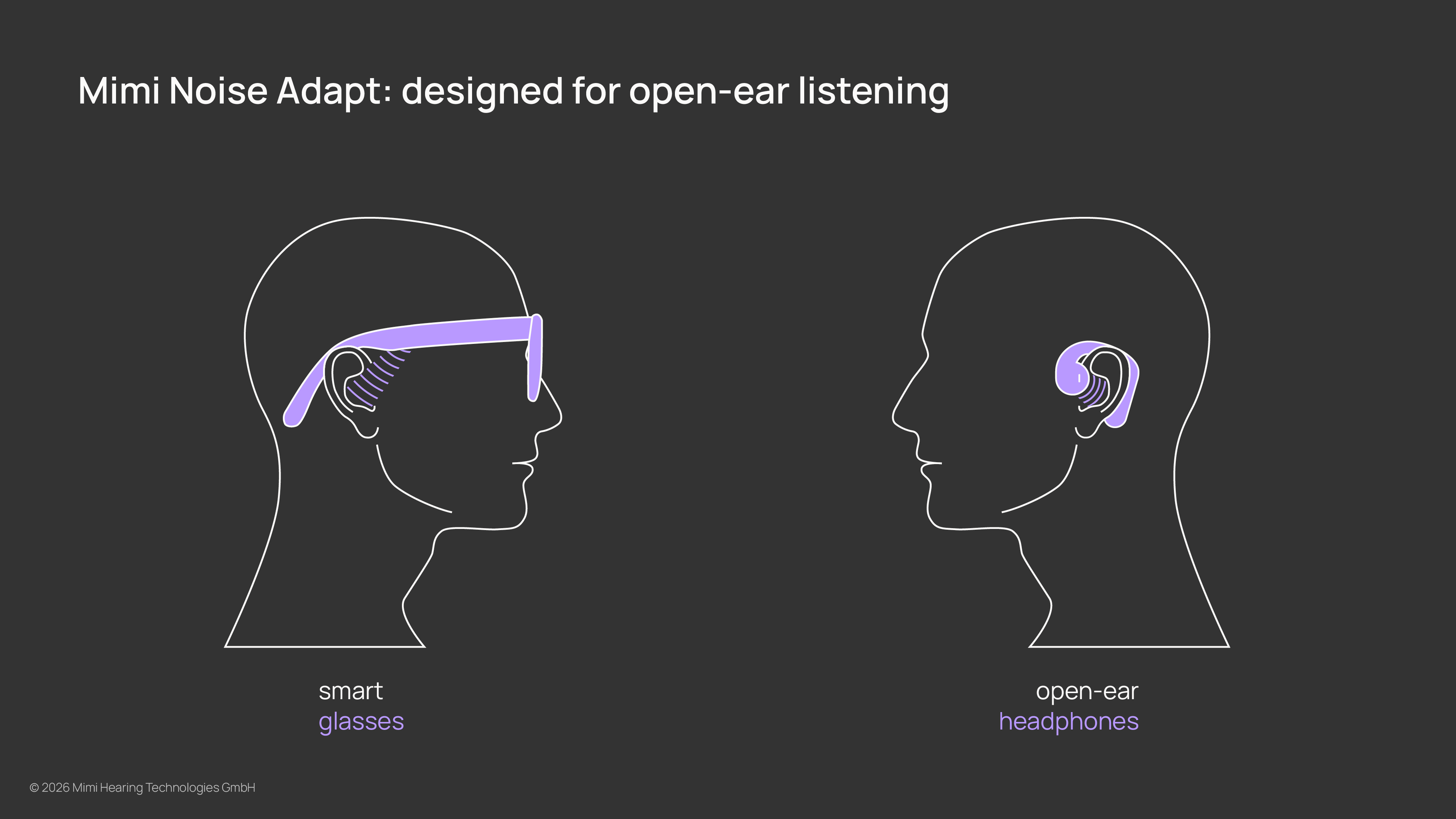
Noise Adapt was built specifically for open listening devices where external noise cannot be controlled.
It is optimized for:
By working with the environment, rather than against it, it enables a more natural and effective listening experience.
While particularly impactful for open-ear products, the same principles can also enhance audio clarity in TWS devices, especially in dynamic, noisy settings where environmental awareness is desired.
A shift in how audio adapts to noise
As wearable audio evolves, the goal is no longer just to block out the world, but to adapt intelligently within it.
Noise Adapt represents a shift:
- from increasing volume → to restoring clarity
- from avoiding noise → to understanding and reacting to its impact on the signal
Frequently asked questions
What is Noise Adapt?
Mimi Noise Adapt is an adaptive audio processing solution that restores signal components masked by environmental noise, improving audio clarity in noisy environments without increasing overall device volume.
How does Noise Adapt work?
Mimi Noise Adapt continuously analyzes the surrounding environment and the incoming audio signal. Based on this analysis, it dynamically adapts playback in real time to maintain clarity as noise conditions change, while preserving a natural listening experience.
How is Noise Adapt different from ANC?
Mimi Noise Adapt restores the audio details that noise masks, while Active Noise Cancellation (ANC) reduces or removes environmental noise. This makes Noise Adapt particularly suited for open-ear devices, where maintaining situational awareness is essential and the level of the external noise cannot be controlled.
What devices is Noise Adapt designed for?
Mimi Noise Adapt is optimized for Open Wearable Stereo (OWS) devices such as open-ear headphones, smart glasses, and hearing glasses. It can also support audio clarity in other device categories, including TWS, in dynamic listening environments.
Why is Noise Adapt important for open-ear devices?
Open-ear devices preserve situational awareness, but they also expose listeners to environmental noise. Noise Adapt helps maintain speech and media clarity in dynamic acoustic conditions.
Find out more
Discover how Mimi Noise Adapt can bring clearer, more natural listening to your open-ear products: