
Written by Florian Schneidmadel - CEO, Mimi Hearing Technologies
The rise of open-ear headphones and smart glasses, also known as OWS (Open Wearable Sound) devices, reflects a broader movement toward more natural, comfortable, and connected listening. Instead of sealing the world out, open-ear designs invite it in, letting users enjoy audio while remaining aware of their surroundings. Their long-wear comfort also makes them especially suited for hearing enhancement features, a segment that remains massively underserved despite substantial unmet need. Today, more than 1.5 billion people live with some degree of hearing loss, yet the majority receive no form of support.
But open-ear audio isn’t just a new form factor; it also introduces significant acoustic and engineering challenges. These include delivering clarity without a seal, maintaining imperceptible latency, controlling feedback and leakage for hearing enhancement, and optimizing sound personalization for intelligibility in noise. Overcoming these hurdles is crucial for open-ear devices to become an everyday alternative.
At Mimi, it has always been our mission to bring scientifically grounded hearing technology to the devices that consumers use every day. Now, as open-ear designs mature and the category grows, we’re applying our ten years of research and Edge AI expertise to address some of the category’s complex challenges and power the new generation of open-ear devices with our hearing intelligence technology.
How the market is changing
The broader personal audio market continues to grow, largely by the sustained strength of True Wireless Stereo (TWS) devices.
Today, TWS represents a $40+ billion market, but its rapid early growth has moderated. Counterpoint research data shows that the category once surged 78% YoY in 2020 and a further 33% YoY in 2021, yet is now entering maturity, with growth expected to slow to around 3% in 2025.
Although still small in total size, the strongest momentum is now coming from open-ear and wearable audio. Market data for open-ear devices is still developing and therefore reported values vary somewhat, but all sources project strong growth.
Open-ear headphones
Some of the projections currently reported for open-ear headphones estimate today's market value anywhere between $1.2 billion and $2.04 billion, with forecasts expanding to $3.5 to 4.2 billion by 2032. Concentration in this segment is high among a few key players, notably Sony, Bose, and soundcore by Anker, who control approximately 40% of the market share. However, a large number of small to medium players, including 1MORE, Shokz, QCY, Cleer Audio, and Skullcandy are successfully entering this category with new open-ear models.
Smart glasses
Even more dramatic growth is occurring in smart glasses. Meta’s Ray-Ban Meta line has quickly become a category leader, reporting 300% year-over-year sales growth in their Q2 2025 earnings call. Their partner EssilorLuxottica has already announced that they expect to reach the 10 million unit capacity that it had originally planned to hit by the end of 2026 earlier than anticipated. To back up their ambitions, Meta has invested $3.5 billion into EssilorLuxottica.
Also reported by CNBC, “Alphabet announced in May a $150 million partnership with Warby Parker to develop smart glasses powered by Google’s Gemini AI digital assistant, while China’s Alibaba unveiled its smart glasses in July that utilize its Quark AI assistant. Apple and OpenAI are also reportedly developing smart glasses.”
Hearing glasses
Parallel to the growth in smart glasses, a new subcategory has also emerged: hearing glasses.
They are smart glasses that integrate a discreet, open-ear hearing aid system into a pair of glasses, with the option to add prescription lenses. Nuance Audio (parent company: EssilorLuxottica) has emerged as a key player in this area, claiming to be “the hearing and vision solution in one” and offering discreet, fashion-forward eyewear that is also a hearing aid alternative that doesn’t go in your ears at all.
Common challenges
Because open-ear devices operate without a physical seal, both the speakers and microphones are exposed to the open environment. This brings with it a unique set of challenges when compared with traditional over-ear or in-ear designs.

Acoustic and listening challenges
- Low-frequency limitations: Low-frequency reproduction is inherently challenging in open-ear designs due to the lack of a physical seal.
- Situational hearing loss: In everyday environments, competing sounds, background noise, and variable acoustics can lead to a kind of situational hearing loss: Spoken words in podcasts or audiobooks can easily get drowned out, music in details get masked, and overall listening effort increases, even for those users with only mild hearing variability. Without personalization, overall clarity can suffer, creating a gap between the promise of open-ear design and the reality of real-world listening.
Conversation enhancement challenges
These challenges arise only when an open-ear device steps beyond media playback and begins actively processing the world around the listener.
- Edge AI: While AI-based models can improve conversation enhancement performance significantly, deploying them on open-ear devices can be technically challenging. In order to enable faster audio processing and privacy, it is required to deploy the AI-based models on the audio product, instead of processing on a central cloud. Porting and running these AI models on edge devices like headphones is difficult and requires deep understanding of both embedded hardware and AI audio algorithms.
- Feedback risk: With microphones placed close to the speakers, the system is far more prone to feedback loops.
- Latency sensitivity: In open-ear scenarios, the original acoustic sound reaches the ear unattenuated. Any perceivable latency becomes immediately noticeable, creating echo-like artifacts that users perceive as unpleasant or unnatural, particularly in hearing-enhancement modes.
- Own voice amplification: Open-ear devices can unintentionally amplify the user’s own voice, making it sound distorted, especially during calls, voice-interactive use cases, or in-person conversations.
Mimi’s role in enabling the next generation of open-ear sound
Mimi’s hearing intelligence offer is a set of science-based technologies that address the common challenges in this category. By integrating Mimi into open-ear devices, manufacturers can deliver sound that intelligently compensates for individual hearing variability and real-world acoustic challenges inherent to open designs, resulting in clearer, more personalized hearing enhancement.
For people with mild to moderate hearing loss, AI-powered hearing-enhancement features can make a meaningful difference, helping them hear better without changing their habits or purchasing additional devices. This represents a major opportunity, especially for the 1.44 billion people worldwide with mild to moderate hearing loss, most of whom currently use no hearing enhancement solution at all.
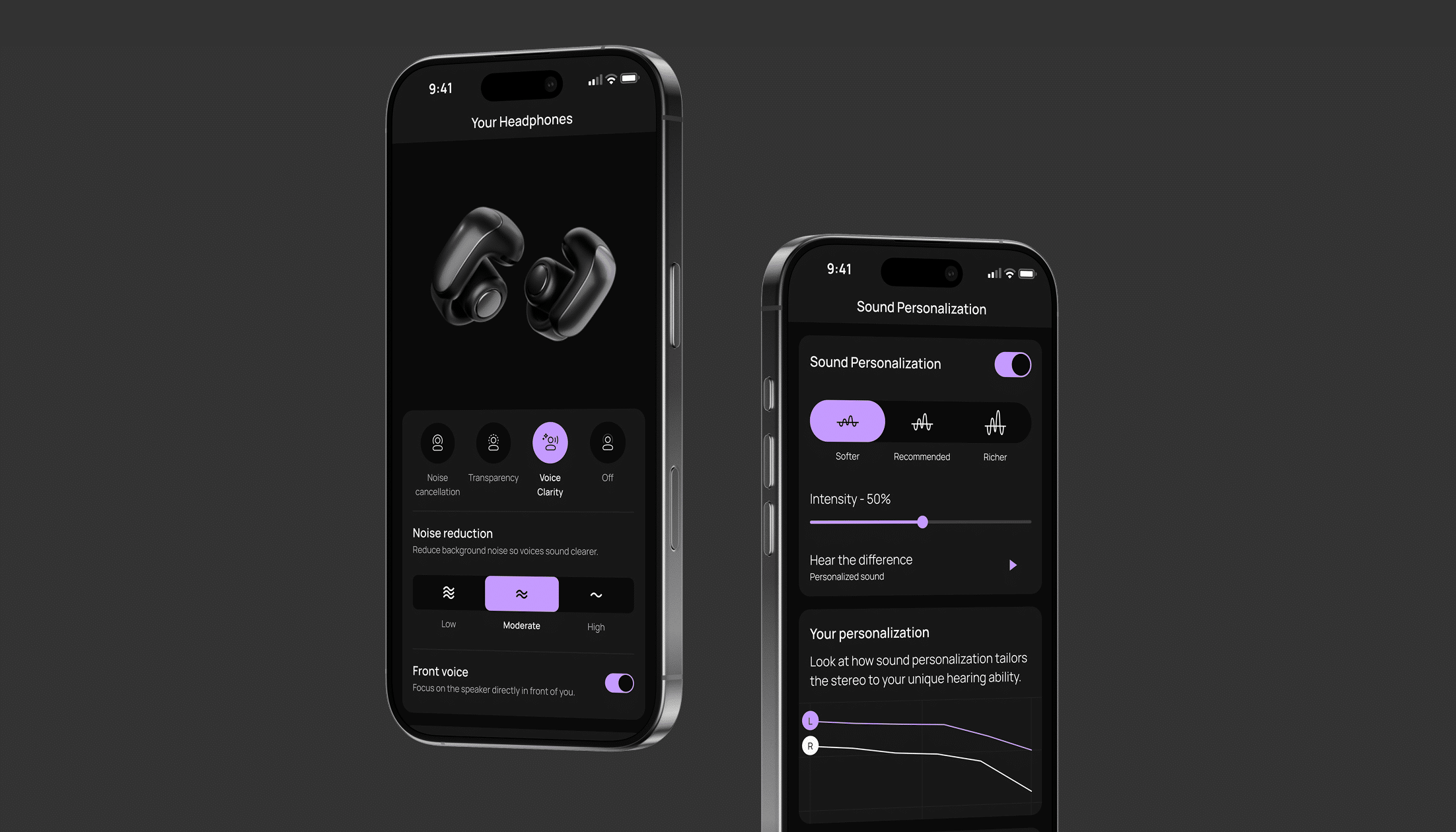
Mimi Sound Personalization
Mimi Sound Personalization adapts audio to each individual’s unique hearing profile, ensuring clearer detail, balanced frequency perception, and reduced listening effort.
From its earliest development, the technology was designed to deliver more meaningful information from an audio signal to the brain, even in the presence of masking noise, and without relying on higher volume. The result? Turn up the details, not the volume.
This foundation already directly addresses the situational hearing loss many users experience with open-ear devices. In noisy environments, our processing enhances the audibility of media content such as podcasts, music, and movie dialogue, ensuring that important details remain clear and intelligible.
This can then be further enhanced with dedicated Sound Personalization OWS modes that apply frequency-dependent gain and compression to maintain consistent audibility across different background noise profiles, without unnecessarily boosting signal levels.
Mimi Voice Clarity
Mimi Voice Clarity combines advanced sound processing with personalized hearing profiles to intelligently focus on the speech you want to hear, allowing for clearer in-person conversations.
Open-ear headphones and glasses can be worn comfortably for extended periods of time, unlike in-ear headphones which often become uncomfortable with prolonged use. This comfort makes open-ear form factors naturally suited to offering hearing enhancement features, giving users more effortless listening experiences even in challenging environments.
Rather than simply making everything louder, Mimi augments sound with a combination of unique solutions and optimized technical building blocks tailored specifically for open-ear architectures. These include:
- AI-based voice enhancement that runs directly on edge devices with low latency (4 ms)
- Feedback cancellation (15–20 dB)
- Two-microphone beamforming to focus on speech and reduce ambient noise
Together, these technologies enable a total acoustic gain of up to 20 dB, which is a strong performance level for open-ear systems. By combining noise reduction, beamforming, and feedback cancellation, Mimi reduces unwanted sounds and background noise, causing the speech signal to be perceived as up to four times louder. The result is substantially improved speech intelligibility, even in noisy environments.
Read more in our interview with Peter Möderer, Former Product Director & John Usher, Lead Sound Engineer: "Voice Clarity: How Mimi is enhancing real-time communication for headphone users"
Mimi Hearing Test
Accurate hearing assessment is essential for delivering personalized hearing enhancement in open-ear devices.
Mimi has developed two hearing tests:
- Pure-Tone Threshold (PTT) Test
- Masked Threshold (MT) Test
While background noise can present a challenge with hearing testing on open-ear devices as it might interfere with the test signals, our MT Test, which uses a suprathreshold masking paradigm, is relatively insensitive to low or moderate levels of background noise. This makes it ideal for testing in open-ear scenarios. In addition, the test allows users to adjust the sound volume at which they perform the hearing test, ensuring they can compensate for their surroundings and achieve a reliable result.
Looking ahead
The open-ear category is on track for exponential growth, and at Mimi we are ready to help power this transition with our proven Edge AI hearing technology for consumer devices.
By enabling truly personalized listening and real-time hearing enhancement in open-ear headphones and smart glasses, we are creating meaningful and tangible value for brands and users. This is especially impactful for the more than one billion people with mild to moderate hearing loss who currently lack any form of hearing support.
As hearing enhancement and sound augmentation become mainstream features in consumer electronics, Mimi’s solutions will play an essential role in bridging the gap between traditional hearing care and the audio products people already rely on. New form factors and device categories will accelerate this evolution, bringing more affordable, accessible, and higher-performing personalized sound and hearing enhancement features to millions of users worldwide.
Meet me at CES 2026

Want to experience our latest breakthroughs in open-ear audio and Edge AI firsthand? Meet me at CES 2026.
Location:
Venetian Hospitality Suite
3355 Las Vegas Boulevard South
Las Vegas, Nevada 89109
Dates: Tuesday, January 6 – Friday, January 9, 2026
Resources
Articles and Overviews
- Bose: What Are Open-Ear Headphones & How Do They Work? | Bose
- CNBC: Ray-Ban maker EssilorLuxottica says Meta smart glasses boosting growth.
- Hey Up: Meta Smart Glasses Sell Out in Two Days: What’s Behind the Craze? - Heyup
- Neuberger Berman: Will Smart Glasses Replace Smart Phones? | Neuberger Berman
- Soundly: Nuance Audio Hearing Glasses Review: Features, Price & How They Compare
- The Spatial Studio: Smart Glasses definition and description
- WRAL News: Google, Meta and Snap think this tech is the next big thing
Market Research and Industry Insights
- Archive Market Research: OWS Headphones Decade Long Trends, Analysis and Forecast 2025-2033
- Counterpoint: Global Smart Glasses Market Soars 210% YoY in 2024 Driven by Ray-Ban Meta Smart Glasses
- Counterpoint: TWS Market Entering Maturity, Poised for Moderate Growth Through 2028
- Counterpoint: Global TWS Market to See 33% YoY Growth in 2021
- Date Intelo: Open Ear Headphones Market Report | Global Forecast From 2025 To 2033
- Futuresource Consulting: World Hearing Day 2025 and the role of innovation in hearing health | Futuresource
- Futuresource Consulting: Hearables market to achieve 670 million shipments by 2026 | Futuresource
- Mordor Intelligence: True Wireless Stereo (TWS) Market Size, Share, Trends & Research Report, 2030
- Research Gate: Hearing loss prevalence and years lived with disability, 1990-2019: Findings from the Global Burden of Disease Study 2019
- World Health Organisation (WHO): Deafness and hearing loss
- 360iresearch: OWS Open Ear Headphones Market Size & Share 2025-2032