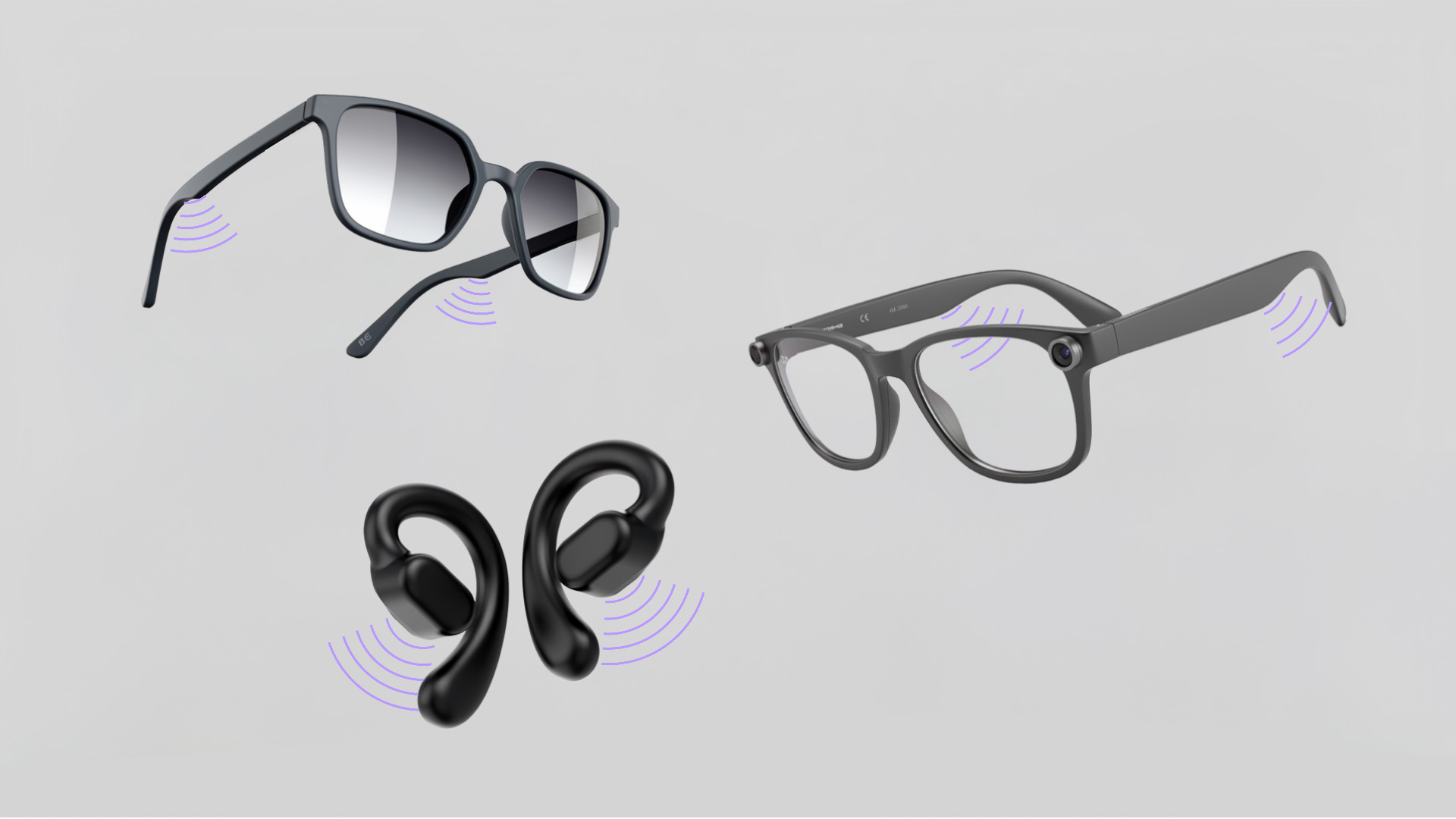
Open-ear audio has moved from a niche concept to a fast-growing category across consumer electronics. As users demand greater situational awareness, all-day comfort, and seamless integration into daily life, manufacturers are exploring new form factors that deliver audio without blocking the ear canal.
Open-ear audio technology
Open-ear audio technology allows users to hear digital audio content while remaining aware of their surroundings. Unlike traditional in-ear or over-ear headphones, open-ear devices do not seal off the ear canal. This makes them particularly well-suited for use cases where safety, comfort, and social awareness matter, such as commuting, working, exercising, or extended daily wear.
There are two primary audio delivery technologies used in open-ear devices: bone conduction and air conduction.

Bone conduction
Bone conduction technology transmits sound vibrations through the bones of the skull. With direct bone conduction, a speaker is placed against your cheekbones or temples. The speaker transmits vibrations directly into the bones of the inner ear, bypassing the outer and middle ear entirely. When these tiny bones vibrate, they send a message to your brain that is interpreted as sound.
Key characteristics:
- Keeps the ear canal fully open
- Highly effective for situational awareness
- Often favored for sports, industrial, or accessibility use cases
- Audio fidelity can be limited compared to air-based solutions
Bone conduction has been foundational in medical and assistive hearing applications. It also continues to influence consumer-grade open-ear designs, as shown in a recent TechRadar roundup of bone conduction headphones that highlights the strengths and limitations of leading headsets in this category: The best bone conduction headphones 2025.
Air conduction
Air conduction open-ear systems use precisely directed speakers to send sound waves through the air toward the ear canal, without sealing it. This approach more closely resembles traditional headphone acoustics but relies on advanced speaker placement, acoustic engineering, and signal processing to prevent sound leakage and maintain clarity.
Key characteristics:
- Higher potential audio quality than bone conduction
- More flexible tuning and personalization
- Compatible with software-driven enhancements like hearing optimization
- Increasingly popular in lifestyle and premium consumer products
Air conduction has become the dominant approach for many modern open-ear devices. Soundcore notes, ”When it comes to sound quality, the narrative often tends to favor air conduction over bone conduction. Open-ear headphones with air conduction generally offer a richer and more refined listening experience. They utilize the ear's natural acoustics, providing a wider frequency range and clearer audio output.”
Open-ear device form factors
Open-ear headphones
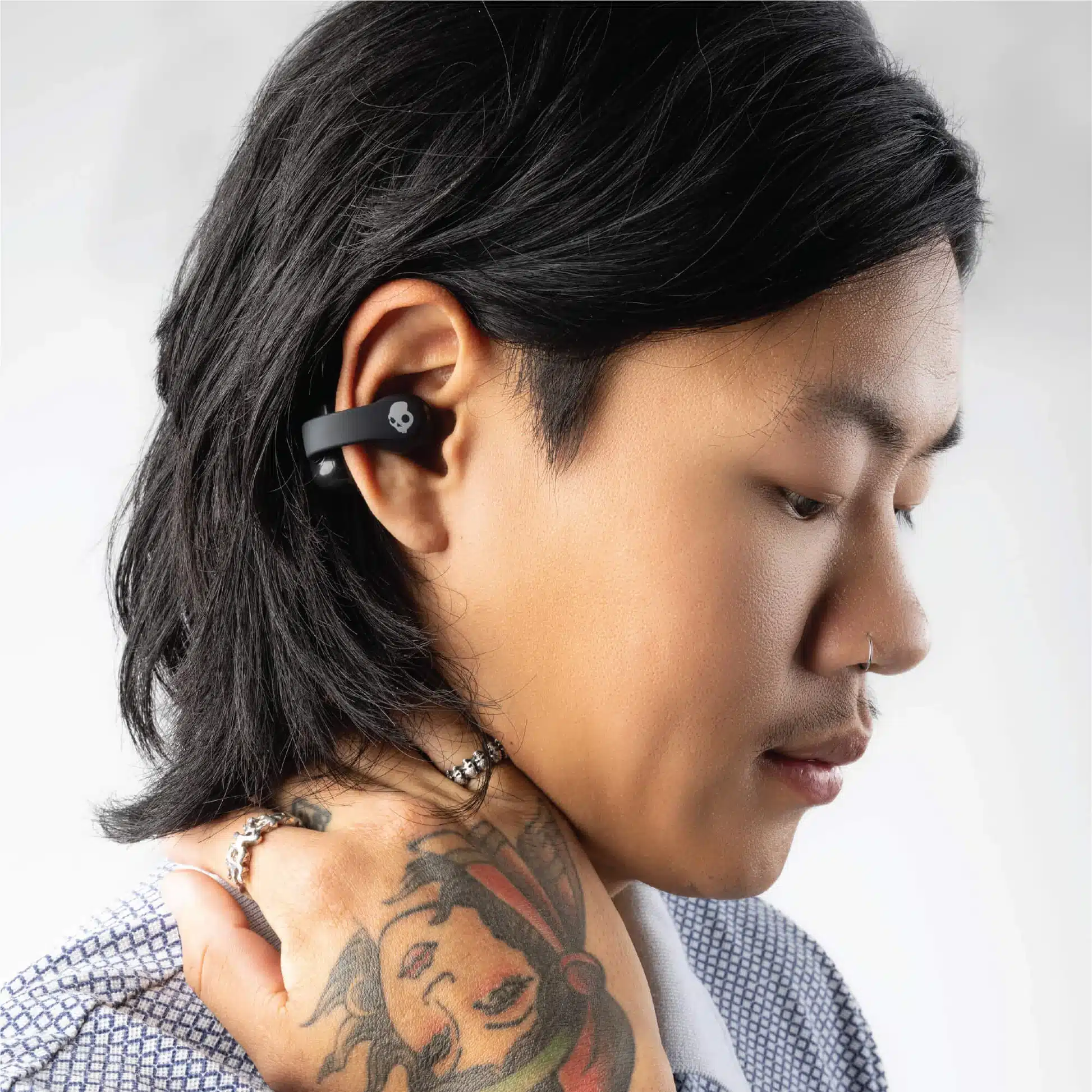
Open-ear headphones are a device category defined by their non-occluding design. Depending on the product, they may use air conduction or bone conduction to deliver audio while keeping the ear canal open. Today, most lifestyle-oriented open-ear headphones use air conduction, while bone conduction remains popular for sports, safety, and accessibility-focused use cases.
Open-ear headphones are currently the most established category in the open-ear market. As Bose explains, “open-ear headphones don’t sit inside your ear, and they don’t block off your ear canal. Instead, these earbuds sit farther out on your ear, generally wrapped or hooked around the edges of your ear for stability. This offers the best of both worlds: You can remain completely open to everything going on around you while still experiencing excellent audio quality.”
Smart glasses
Smart glasses represent a convergence of audio, vision, and computing. For smart glasses, audio has typically been focused on media playback, calls, voice assistants, and notifications.
As outlined by The Spatial Studio, “smart glasses are eyewear that is equipped with integrated electronics and sensors to provide advanced features such as augmented reality (AR), information displays and interactive controls. They often come with features such as a camera, microphone and internet connection to enable seamless integration into everyday digital life.”
As adoption grows, open-ear audio will play a central role in making these devices practical for all-day wear, and will be essential for maintaining awareness and enabling natural interaction with the surrounding environment. As a result, audio quality, speech clarity, and personalization become critical differentiators in smart glasses design and development.

Hearing glasses
Hearing glasses, by contrast, sit at the intersection of consumer electronics and hearing health. They integrate a discreet, open-ear hearing aid system (designed for adults with mild to moderate hearing loss) into a pair of glasses that can also accommodate prescription lenses. This combination offers a convenient way to meet both hearing and vision needs with a single device.
Soundly describes how, “wearers experience hearing amplification without traditional earpieces, all while wearing what looks and feels like a normal pair of glasses. This innovative combo tackles common barriers that keep people from using hearing aids, including:
- Visibility concerns – No one can tell you’re wearing a hearing aid
- Discomfort – No earbuds or earmolds; your ears stay open
- Inconvenience – One device handles both hearing and vision.”
By embedding open-ear audio into glasses with prescription lenses, hearing support is being reframed as a lifestyle technology rather than a medical device.

Looking ahead
As sound delivery becomes less direct, intelligent audio processing, personalization, voice clarity features, and edge-based AI are essential to delivering consistently great experiences across all of the open-ear form factors.
This is where Mimi’s decade of hearing research and scalable personalization technologies can help power the next generation of open-ear devices, without adding friction for users or complexity for manufacturers.
Read more in our blog: https://mimi.io/blog/powering-the-future-of-open-ear-audio-with-edge-ai-and-a-decade-of-mimi-research
Resources
- Bose: Understanding open-ear audio technology
- National Library of Medicine: Hearing Through Bone Conduction Headsets - PMC
- Soundly: Nuance Audio Hearing Glasses Review: Features, Price & How They Compare
- Soundcore: How Do Bone Conducting Headphones Work? (Explained)
- TechRadar: The best bone conduction headphones 2025 | TechRadar
- The Spatial Studio: Smart Glasses definition and description